Days: 555-557 (1 January 2016 – 3 January 2016)
Total distance travelled: 140,322.1 kilometres (87,156.59 miles)
Our morning began with a morning stroll from hostel to bus station and with minimal fuss, we were on board and away for our four hundred and thirty kilometre journey from Shiraz to the desert city of Yazd.
It promised to be a long day, but compared to many of the bus journey’s already under our belt, really it was small fry (come on, everything is small fry compared to our four days across Canada… twice!)
Our Swiss friends were already a day ahead of us by now, but thanks to the joys of Whatsapp, Sarah had managed to stay in touch, and they’d actually ascertained that there were beds available for us at the same Hotel, so rendezvous of sorts was on the cards.
In regards the journey itself, there wasn’t a whole lot to see.
Wide open expanses of dry, rock strewn desert, with the odd surprise for good measure.
Snow, a great example of such a surprise!
First it appeared in the distance, a powdery decoration atop distant mountains, but in time it came closer, covering the roadside and even causing a group of locals to delay their own journey and instead partake in a snowball fight!
We had no such opportunity, confined as we were to our coach.
There was also the odd caravanserai, their stone and/or mud walls now crumbling revealing the courtyard within.
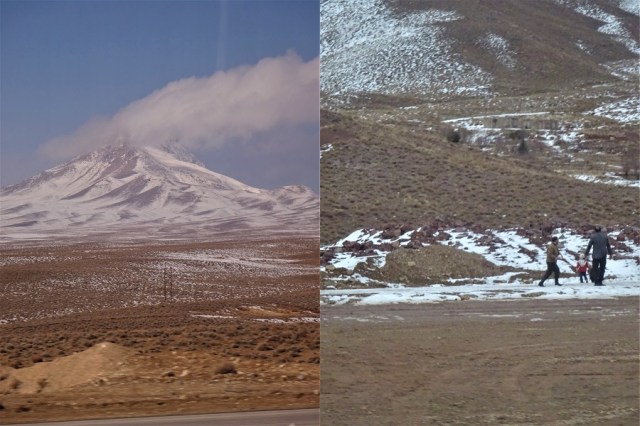
Contrasts: Snow and desert (left) & Local snowball fights… taken from a moving bus… at high speed (right)
By late afternoon we’d made it to Yazd, a dull grey sky and the relatively empty streets giving it the feeling of a city now abandoned.
It obviously wasn’t, but the fact that it was in fact a Friday (a weekly holiday in Islam) meant that people were conspicuously absent and much was closed.
The passenger terminal where we’d been dropped was some ten or more kilometres distant from where we needed to be, so after a short stint on a local bus, we figured we were close enough to walk the last three or four kilometres.
As we stood on the roadside trying to get our bearings, a local appeared, seemingly intent on assisting.
We were flicking through our guidebooks map of the city, whilst comparing where we were with where we needed to be (which we quickly ascertained), and politely declined his offer.
He followed us for a few moments, before jumping aboard a passing bus and seemingly out of our lives.
Either we walked faster than we’d realised, or perhaps the bus was painfully slow, but as we passed another bus stop further down the road, he suddenly left the bus to our left and continued his pestering.
“I need money, you need guidance” (which we didn’t)
One could only admire his persistence, but he did eventually leave us alone.
Eventually we got to the neighbourhood in which our hotel stood, the only thing was, we couldn’t find it!
Well sort of… I’ll do my best to explain a little better.
Thus far we’d followed major roads up to this point, the major arteries that allowed large volumes of vehicular traffic.
Now, we were required to enter a residential neighbourhood proper, and by that I mean narrow, mono-tonal alleyways, totally lacking in street signage.
We decided, that rather than wander aimlessly with our packs, Sarah would wait where we were, whilst I wandered off in search of our hotel.
After several false starts, I eventually received directions from a local driver, and made my way back to where sat in wait.
When I got there, she was bleeding.
Fortunately, she hadn’t been assaulted by local ruffians who made off with all of our belongings.
Rather a few local kids, thought it would be a fine idea to throw some sticks at her (this does not reflect the general populace, Iranians are one of the friendliest peoples you will ever meet).
I sincerely doubt they even considered they’d get close.
One however did, by her accounts their faces turned white when they realised what they’d done, and they bolted off, lest an adult learn what they’d done.
It had struck her on the foot, so with a toe now slightly bloodied, we hobbled our way to our hotel and finally checked in (fortunately, while sore, there was no lasting or serious damage).
We checked in, and relaxed a little before the evening took sway over day.
There was still ample time for a wander however, and not too distant stood a mosque with perhaps the most spectacular lighting budget we’d ever seen.
It’s approach was a street lined with the odd tour operator, others offering taxi services, a few eateries and a couple more selling mattresses (it seems mattresses and taxis is not an unusual combination!?).
At the the end of this short, quirky street stood the aforementioned, the Jameh Mosque of Yazd.
We marvelled a little, took some photos before wandering in.
It was still pretty within, and we even ran into a fellow Australian, had a little chat before going our separate ways, but it was that grand entrance that was truly the star.
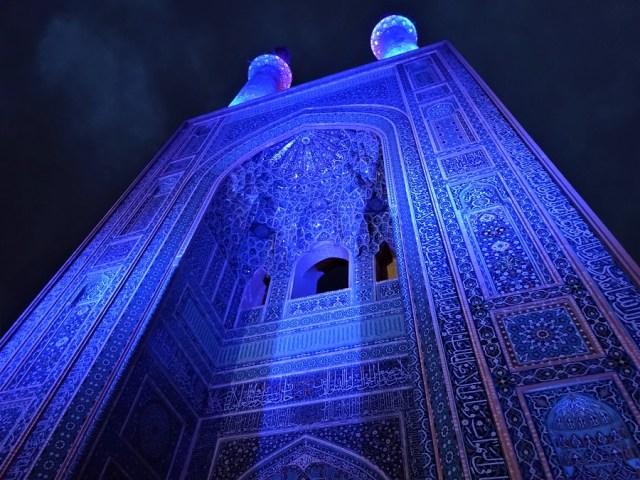
Jameh Mosque. Simply breathtaking by night!
Continuing our evening tour, a little over a kilometre distant stood the impressive (we’d seen it on the way into town), although we had little idea what it was, Amir Chakhmaq Complex.
Before it stood an impressive plaza, whose fountains were at night illuminated in slightly gaudy colours, not completely unexpected for such an impressive mosque or palace.
We passed below the impressive edifice with it’s well lit archways/alcoves, expecting to pass through an entrance into an Islamic holy place… only it wasn’t.
In fact it appeared to be little more than a well lit gate, that had a variety of shops selling skewered meats within.
At least it meant dinner was sorted (apparently there is also a mosque that is part of the complex, but we never saw it)!
Our bellies now full, our course was towards bed, but not before we detoured for another look at the stunning Jameh Mosque, and to book ourselves a day excursion for the following morning (we didn’t however purchase a mattress).
We strolled on, our night done.
Or was it?
Across the road sat yet another, albeit less spectacular after the recent high of the Jameh, mosque.
We hadn’t given it much of a thought when a local man started a conversation, introducing himself as Amir.
Amir, like so many local Persians was both eager to show off their local hospitality, as well as practice his reasonably good English.
To that end, he was quite eager to lead us across the street and take us on a brief tour of this mosque known as Abar Fazl.
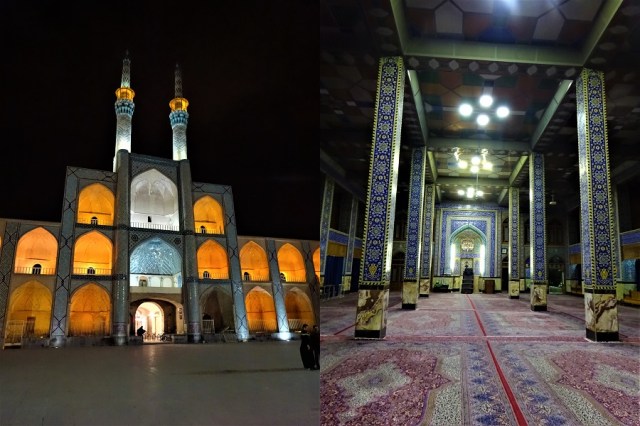
The Amir Chakhmaq Complex. A grandiose gateway to kebab… (left) & Our private tour of the Abal Fazl Mosque (right)
Inside, it was slightly austere and not all that surprisingly empty of worshippers.
It was pretty enough, without the grandeur from which we’d just come.
This was the place wherein the real people prayed, and for the hospitality shown we were grateful.
As mentioned, we’d arranged a tour of sorts for the following day, so after we’d breakfasts on warm flat bread, jam, cheese and tomato, we simply had to sit and wait to be collected.
When the call finally came that our guide was here, what we didn’t expect was that this was our driver with vehicle (it wasn’t that we thought that we’d be on foot for the day, but we were skeptical that any car could reach our hotels location).
We piled into what looked like an old beat up Paykan, it’s white paint chipped and flecked with spots of rust.
Within sat our company for the day.
A pair of women with whom we couldn’t communicate and a young Spaniard, Dani with whom we spoke both English and Spanish.
Minutes later, as our car scraped both it’s front and rear on the narrow alleys mud hewn walls, our earlier assumptions seemed well founded.
Eventually, after a scene reminiscent of an Austin Powers movie (think trying to turn a vehicle through a narrow corridor) we finally emerged from the tight confines and could get on our way.
It was a fairly bleak day.
More overcast skies above the relatively barren landscape didn’t reveal a day full of promise, however when we hit our first stop, the abandoned village of Kharanaq, it seemed quite fitting.
It was a fascinating place, it’s mud brick walls in various states of disrepair.
We wandered rubble strewn alleys that felt more like the tunnels of some war ravaged fortress, and indeed we did wonder what catastrophe or calamitous event had led to the town’s abandonment in the first place.
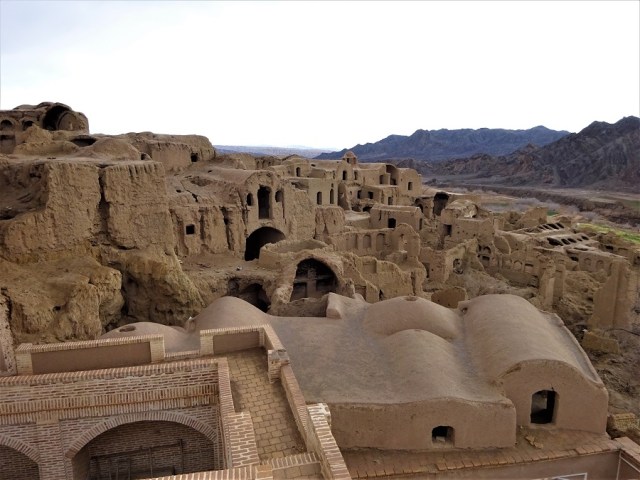
Abandoned: Kharanaq
The truth was a lot less tragic or exciting.
It turns out that modernity had spelled the end for this traditional Persian hamlet.
When a more modern estate connected to power and sewage was built, the younger families simply upped and moved, signalling the end for Kharanaq.
The most solid remaining structures were the village mosque and hammam (bathhouse), the formers rooftop and terrace offering lovely views over town.
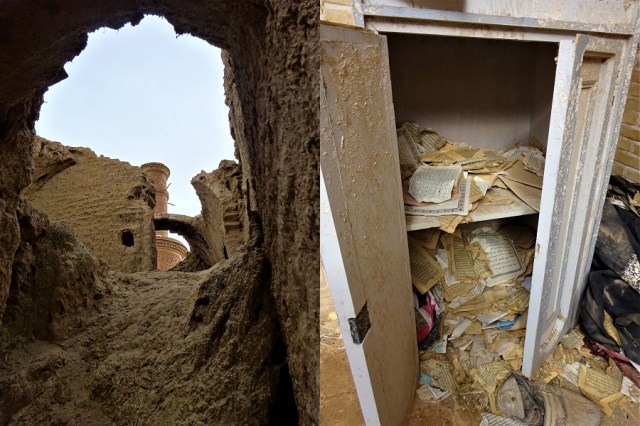
Walls of crumbling mud (left) & Inside the now neglected mosque (right)
I was quite surprised to see the interior in such a state of neglect (not so much that the place was crumbling, but rather the apparently sacred scripts strewn all over it’s floor) given the power and reverence Islam holds over the country.
We explored a few more tunnels, beams of light catching the light through holes in the once solid ceiling, suggesting that perhaps not every level above could hold ours, or the wright of anybody else.
Soon, we were back in the car, the skies above still bleak as we trundled our way through the Martian like landscape.
The flat barren landscape was punctuated by sharp, jagged peaks whose colour married perfectly with the compact sand over which we travelled.
Roughly forty kilometres seated on blanket covered vinyl, and we turned towards one of these rocky escarpments, our next destination before us.
This location, seemingly in the middle of the desert, was Chak Chak.
Our car was parked at the base of this mountain, despite the road seemingly continuing someway upwards, through what looked like a village that clung to the rock face above us… only like Kharanaq, there were no people here.
Despite its appearance, this wasn’t in fact a village, but rather what is apparently the (or one of the) most sacred locations in the Zoroastrian religion (or is it a cult, I’m not sure what the distinction is these days).
Anyway, we had to walk from here on, a relatively steep ascent for us, that left us puffing and panting.
For Dani, our new Spanish friend who was somewhat less fit than us (let’s be clear, we’re no models of fitness, but we have walked a lot over the past couple of years which hold us in reasonable stead), this was a bit more of a challenge.
Credit to him.
Whilst we made the ascent relatively easily, we were still sucking in the air by the time we reached the top (which gave us some decent views over the desert we’d just traversed), it was quite a few minutes before our Spanish companion arrived at the same tier (certainly heavy breathing and perspiration was the order of the day).
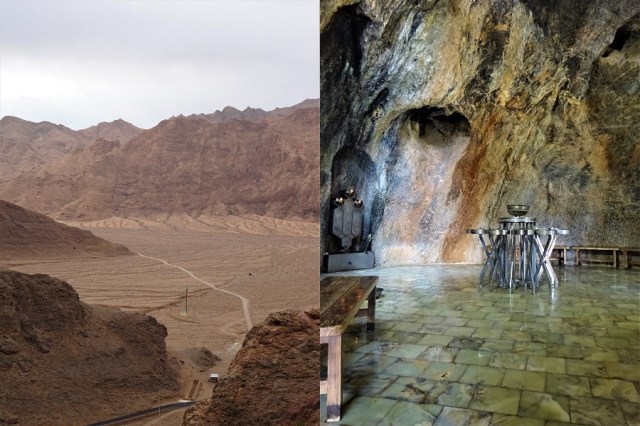
The views from the remote, yet sacred Zoroastrian shrine of Chak Chak (left) & Inside the fire temple (right)
Here, behind a pair of gilded doors (I’ve no idea of it was bronze or gold doors), sat the sacred flame of the site (Zoroastrian’s being worshipers of fire and all… I’m not sure if a correlation between followers and pyromania has ever been established…), flickering away atop a floor of polished marble.
We loitered, took a few photos, trying to imagine the place when it is full of life (apparently ten thousand or so people flock to this remote sanctuary for one of their holy days) and then began our descent.
Before long we were back in civilisation, passing the same mud brick dwellings we’d seen in ruins back in Kharanaq, only here they were adorned with satellite dishes, had wires strung across alleys so their washing could dry… here, it was alive!
This was the city of Meybod, apparently tentatively listed for inclusion for UNESCO World Heritage status.
We pulled into a gravel carpark at one of the reasons why it was being considered for such a listing.
Here, smack bang in the middle of this desert city of almost eighty thousand souls sat this castle, Castle Narin and it was in its shadows that our driver parked his (and our) car.
As we approached, a local man loitering near the entrance began to speak with our driver/guide.
Thinking little of it, it came as some surprise when his interest was actually directed towards our posse.
“He wants to know if you (Dani, our Spanish companion) are American because you are fat!”
Feeling horrible for Dani, yet smirking at the audacity of this local man, we entered this ancient fortress.
From atop its parapets we were granted a lovely view over the city, its walls and roofs mirroring the colour of the desert sands from which it was made, the odd row tall trees standing out like a scar across the vista.
If we gazed down upon the fortifications themselves, it was like something out of a beach sandcastle competition, yet despite its seeming fragility, Narin Q’Leh has stood for almost two thousand years!
Apparently, on a clear day (in fairness, the grey skies above had started to fracture), we’d have the capacity to peer around seventy kilometres in every direction!
Being a site of such cultural and historic importance, the sight of armed guards came as no surprise, but as we explored within the castle itself, one of said guards treated us (not us specifically, we were just fortunately within earshot) to some song, the comprehension of which we had none, but sound wonderful it surely did.
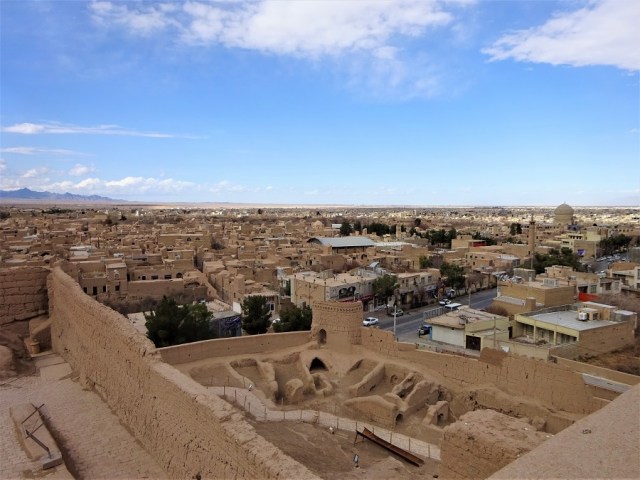
Taking in the city of Meybod from atop Narin Castle
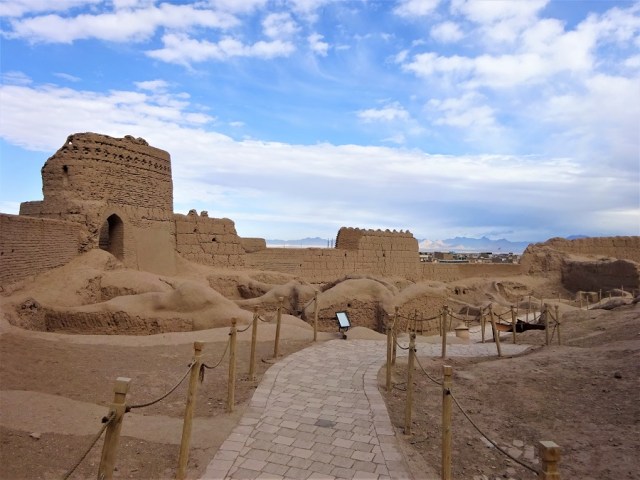
Looking like something out of a sandcastle competition
It was a surreal experience.
First having Dani subjected to Persian insult, only to then be treated to a voyeuristic experience as we caught the soldier in song.
Meybod however was not done with us, as we had a couple more stops yet before this days itinerary was done.
There was the obligatory stop at an old caravanserai, coverted these days into a series of stalls trying to flog trinkets to the few meagre tourists (at least at this time of year) who floated through its heavyset wooden gates.
It did at least posses an impressive old well.
Our other stop however, was much more interesting (the caravanserai was interesting, but it’s hard to explore in comfort with shopkeepers in tow as company).
From the outside, this cylindrical shaped tower looked like some sort of battlement, albeit devoid of any apparent windows, like no even those narrow vertical slits from which arrows could have been fired.
Turns out there’s a very valid reason for this.
It wasn’t some part of an ancient Persian empire, or series of desert fortifications.
Nope, this place was built for birds, more specifically pigeons, and if we’re going to knuckle down to the nitty-gritty, even more precisely, for pigeon shit!
Within, this tower of many niches was devised to capture and allow for collection, bird guano so that the local peoples had a ready supply of fertiliser to help them try and make this arid environment bloom.
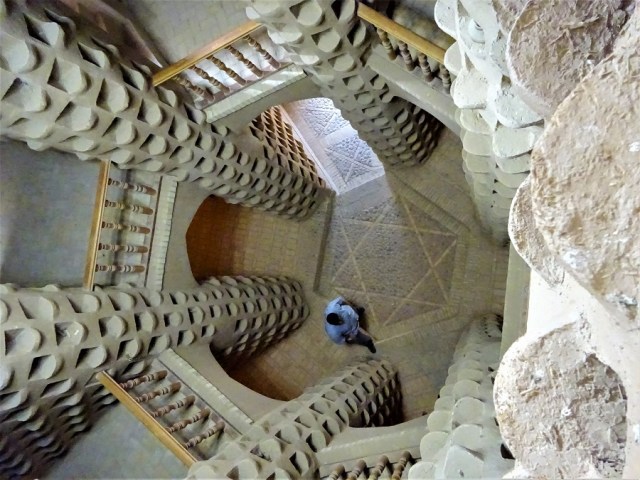
A tower of niches
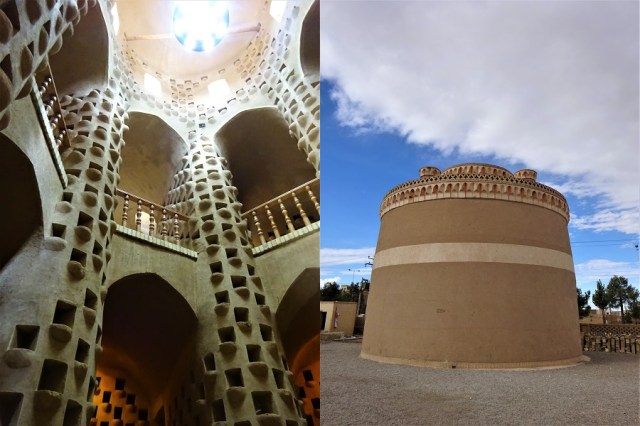
The pigeon tower, inside (left) & out (right)
It was a far more impressive, if younger (at ‘only’ a couple of hundred years old) piece of architecture than we’d ever expected.
That was the end of our tour/day, although we grabbed the contact details of Dani with whom we’d shared the day and shared both English and Spanish conversation.
The following day started brighter than that previous, rather than a blanket of dirty white or dull grey, we head slashes of blue which in turn allowed periods of sunshine, a wonderful combination to enjoy a bit more of Yazd itself.
Situated as it is, tenuously clinging to life in the middle of the desert, water (due to its scarcity and need) is obviously an integral part of survival, so upon reading of the Water Museum of Yazd our interest was certainly piqued.
The museum itself was housed in a beautiful old home, significant as from within its basement you could gain access to the cities ancient sewer system.
It was interesting enough, but made more memorable for the English translations as for the exhibits themselves, a series of photos providing us with this gem (for context, the image itself was of an old man being lowered into a dirt walled hole):
“A blind man is digging a subterranean canal for clear-sighted people and providing water for them. His endeavor is highly appreciated”
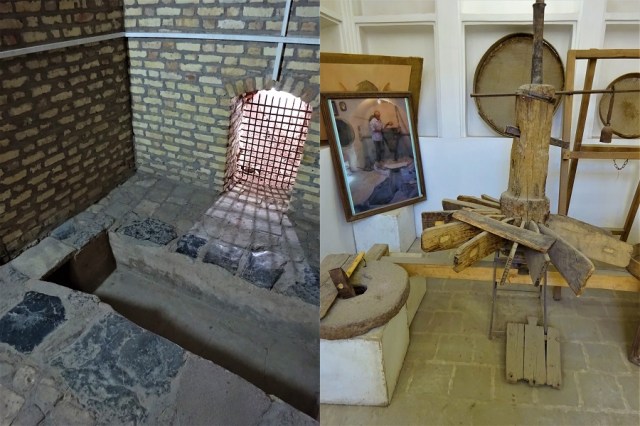
The Water Museum of Yazd (left) & Not at all oxymoronic, despite being in the desert (right)
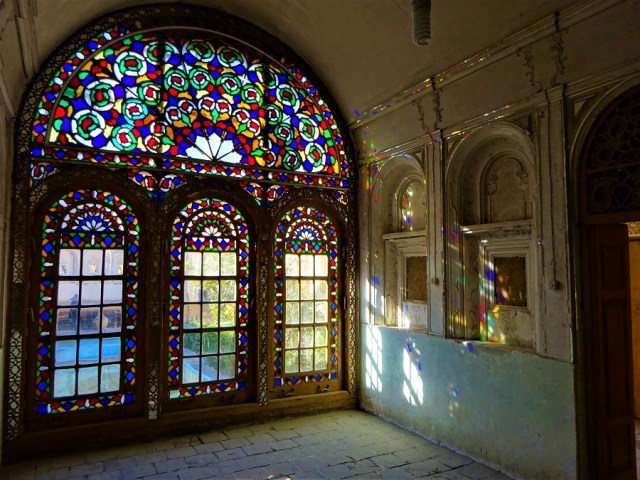
Stunning colours, but little water in this room…
From water, we were again chasing fire, for after another short stroll along the street, where had the inclination or desire struck us, we could have bought either blue or beige plastic sandals branded with the McDonalds (as in the fast food franchise) logo, as in something of a follow up to the previous days excursion out to Chak Chak, Yazd is also home to a Zoroastrian Fire Temple.
The temple itself doesn’t look much, but the eternal flame within (cue The Bangles tune, although i have no idea what the flame itself is actually called) has apparently been burning continuously since four hundred and seventy AD.
I’m assuming in this, it means the fire has been continually fueled, as opposed to the flame just burning from the same coals…
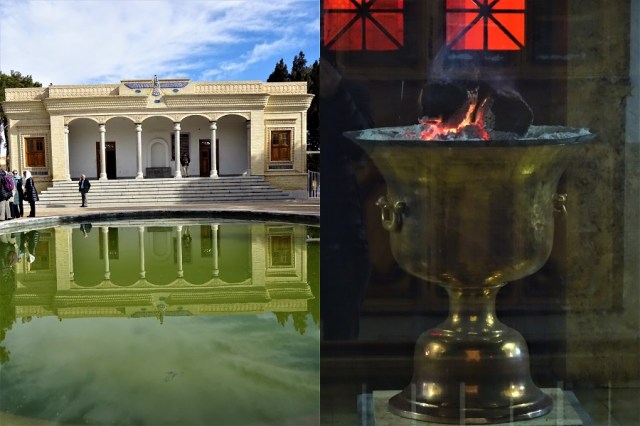
The Zoroastrian Fire Temple (left) & The sacred flame, apparently burning continuously since 470 A.D (right)
We hadn’t research it well, so it was certainly not a deciding factor in our decision to visit this oasis in the desert, however it turns out the city of Yazd, besides being home to gorgeous mosques and quirky cults (or religions, it all depends which fence you sit on I guess), it is also highly famed for its sweets.
So famous in fact, in the years before the 1979 cultural revolution, the Shah and his cronies used to feast on its sugary delights, as did King Faisal of Saudi Arabia (I can think Wikipedia for these last tidbits).
It would have been impolite for us not to therefore indulge as well, so we did!
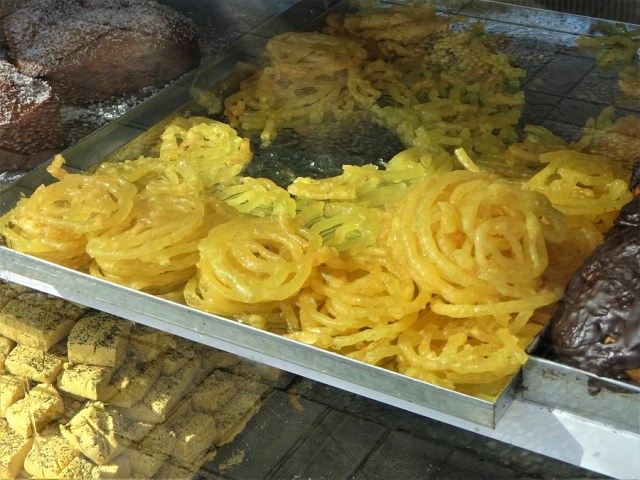
Zulbia (very similar in name and taste to Jalebi)
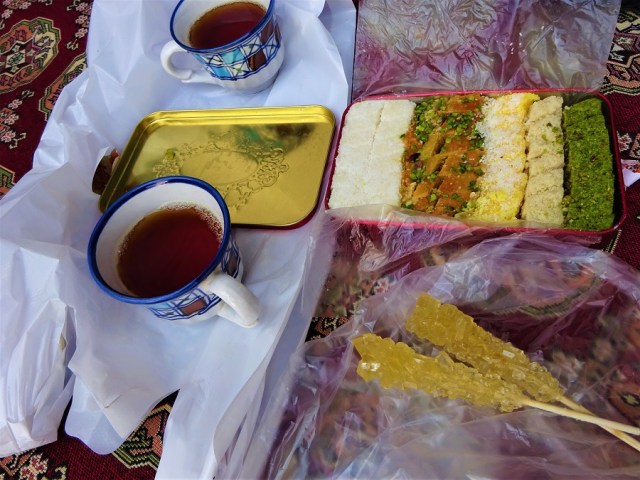
Developing a taste for the local sweets
It wasn’t all designed to simply titillate the taste buds, as some sugary swizzle sticks apparently had medicinal properties to aid with indigestion (possibly as a result of eating a whole tin of Persian Baklava).
Whether a placebo or not, it was certainly all tasty, and a sweet memory for us to take home from the desert.
Notes:
* Our bus from Shiraz to Yazd cost us 300,000.00 Rials each.
* A public bus from the Yazd bus terminal to the downtown area cost about 7,500.00 Rials for each of us.
* The Jameh Mosque is apparently open 24 hours (it’s worth checking out both during the day and at night), and is FREE!
* We booked our day tour through Iranian Tour & Travel Agency www.iraniantour.ir for 500,000.00 Rials per person.
* Entrance into Pir-e-Sabz fire temple in Chak Chak, and both the Ice Chamber and Kaboutar Khaneh Tower (Pigeon House) in Meybod, cost us 50,000.00 Rials per person.
* The price per individual for entrance into the Narin Castle in Meybod was 150,000.00 Rials.
* Entrance into the Yazd Water Museum was 150,000.00 Rials each.
* The Ateshkadeh (Zoroastrian Fire Temple) will set you back 50,000.00 Rials per person.
 theworldwithchrisandsarah
Pingback: Ciudad Universitaria: Salamanca | theworldwithchrisandsarah