Days: 526 (3 December 2015)
Total distance travelled: 1333,622.2 kilometres (82,995. 16miles)
The third day of winter, and our third day in a row of gorgeous sunshine!
We had a plan, and for what we had in mind, local buses jut wouldn’t cut it (basically, they wouldn’t get us where we wanted to go).
That’s how this stunning morning found us cruising along a Turkish highway, Sarah behind the wheel and worryingly for us both, me once again as navigator.
It didn’t bode well.
Armed with a series of maps photographed on our point and click camera from the laptop that had thus far served us for over five hundred days on the road (and a lot longer before we even left home), what could possibly go wrong?
Not far from Selçuk, and we hit Kusadasi…
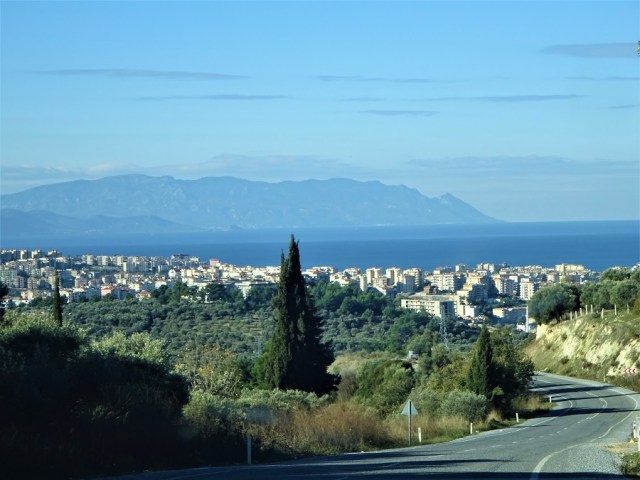
Getting a look at the Aegean on the approach to Kusadasi
Cresting a rise, the bright blue Aegean Sea as a backdrop, before us sat a surprisingly large city.
Here, the failings of my navigational aids were proven.
Sure, we had a route that took us to the coast, then south to the three destinations we’d earmarked, but what’s a fat line on a photo pinched from Google, when it gives you no idea which road to take, or indeed which lane one might even need to be in!
Somehow, we got out, a few random signs and an idea of the general direction needed eventually finding us a way.
By this stage, Sarah was already pretty pissed (as in pissed off, angry) with her navigator…
Roughly seventy kilometres after setting out for the day, we pulled into Priene, and I slunk out of the navigators seat.
We were one of two cars in the parking lot in what was a rather hilly area, so we got to work exploring the place.
It was a setting unlike any other ruin we’d visited, surrounded by conifers, and even though we weren’t at an elevation of significance, the fresh air and smell of pines made it indeed feel mountainous.
Compared to the other Grecian or Roman ruins we’d explored throughout Turkey thus far, it was also nice to have a lovely backdrop of green!
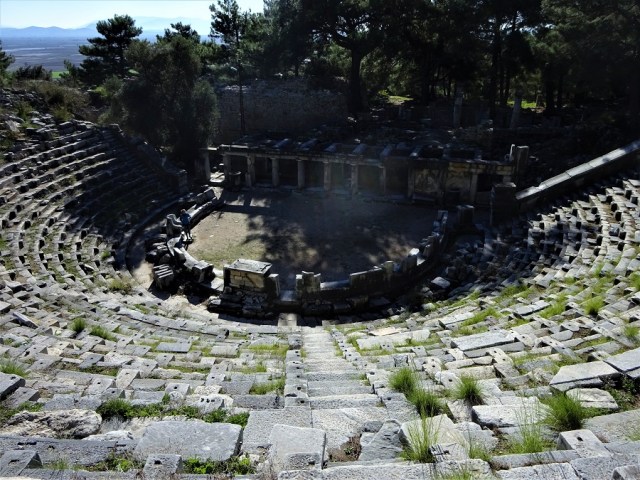
Another day, another theatre…
From these heights, we had great views towards the distant see, but the incredible thing about that whole situation was that this place purportedly once boasted two harbours, yet now, here it sits, kilometres from the coast.
Like any self respecting city of the age, it boasted a grand Temple of Athena, and even today, alongside its small, yet beautiful theatre, it remains the highlight of the site.
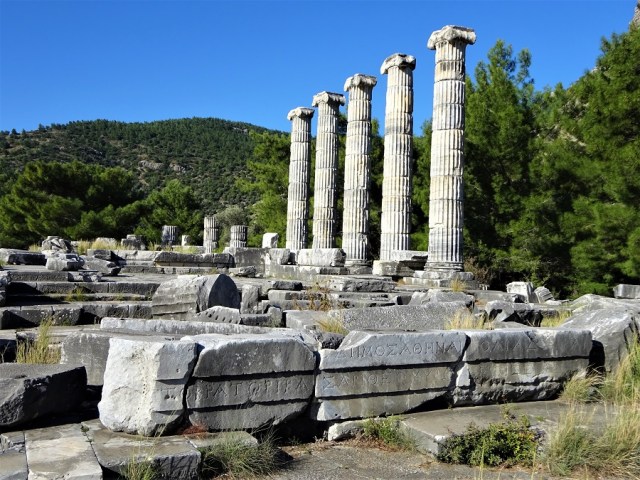
Grandeur, this time in the form of the Temple of Athena
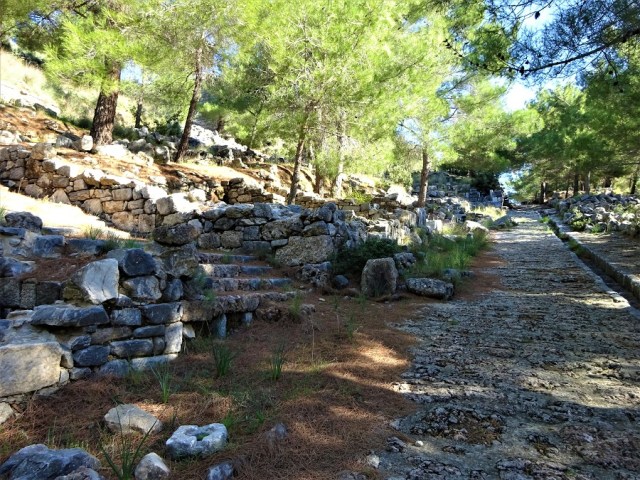
Priene, amidst its gorgeous alpine setting
We wandered the top of this escarpment, it being higher and allowing us those views towards the coast, wondering what the ancient Greek script on fallen stone meant.
Even though I’m sure it’s all been studied by countless scholors, and with no grasp of the script ourselves, I’m sure a part of me deep down wished that we’d stumble across some lost fragment that like the Rosetta Stone, would unravel an ancient mystery.
If you’re an avid reader of National Geographic, I’m sure by now you’ve realised, that missing piece wasn’t found…
The lower levels were home to the Agora (central meeting place), and the natural extension of this was the market, and it did feel pretty cool to wander across a bed of pine needles, as we explored within the walls of shops over two thousand years old.
With the trials of our first few kilometres a little further behind us, we hit the road in a better state of mind, and after little over twenty more kilometres on the road, we were again turning off it.
There was a large parking area, and my the time we’d found a park (wherever we wanted), the number of vehicles waiting here rose from zero to one!
Minutes later, after we’d found the lone guard to point us in the right direction (we really didn’t need the guidance), much like our arrival at Ephesus, we were drawn across a field strewn with the remains of what once formed part of a city, and on the other side of this motley collection… another immense theatre!
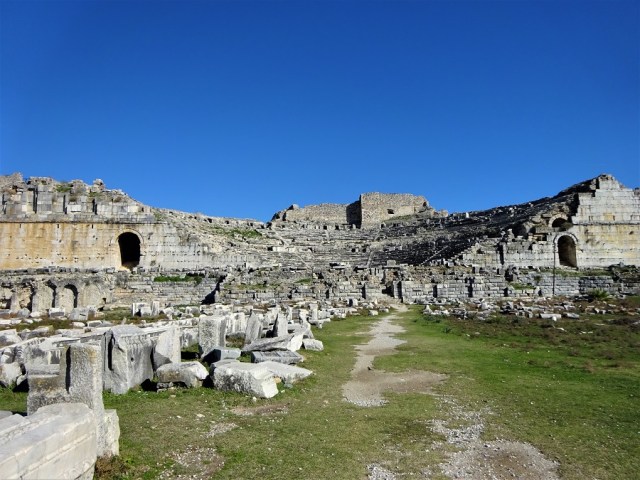
Suddenly, the theatre in Priene seemed like small fry…
You wouldn’t believe, but apparently this thing only had a capacity of around six thousand revellers. That is, before the Romans turned up and pimped it to the tune of another ten thousand capacity (at least I think that’s what I recall reading).
We marvelled at it from its stage, then began to climb, but up and through this behemoth before we now had the chance to take it in from another, equally impressive perspective.
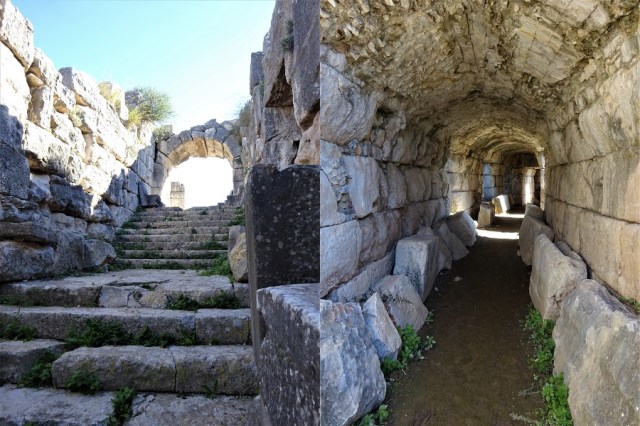
On and up (left) & Then through the bowels… (right)
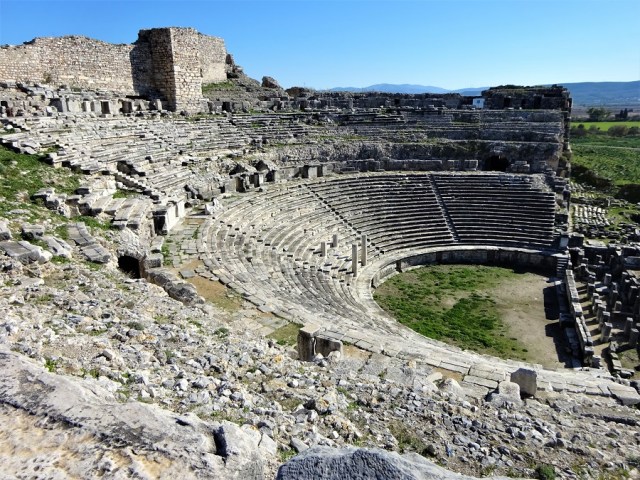
All to take this in from a different aspect
It was a day that took us back to our time in Mexico, where often we’d be at these amazing historical sites, yet have them all to ourselves!
From atop the amphitheatre, we were able to walk our way down its backside, these days a rock strewn, scrubby hill, and explore what remains of the rest of the city.
Once upon a time I’m sure there were a vast array of buildings, but hundreds of years exposure to the elements meant much was now lost.
The baths were in surprisingly good condition, although it’s original statues now stood proudly on display in the nearby museum, and its pools were oddly lacking in water.
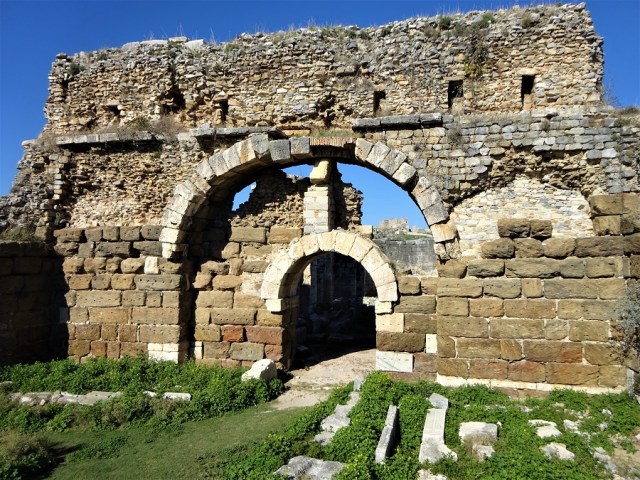
The entrance to the ancient baths
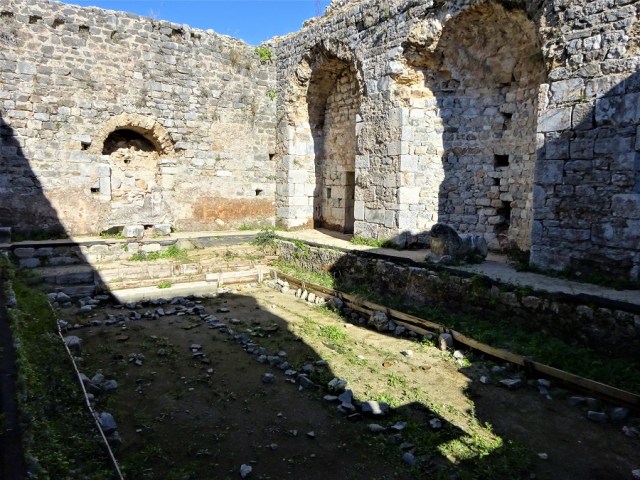
Once upon a time, one could bathe here under the watchful gaze of the river gods (those statues on the fringe)
I only say oddly, in the sense that elsewhere, many other areas of the city had taken on something of a Venetian feel, with large tracts of water now pooled where roads and plazas once lay.
Perhaps time had seen a little role reversal take place?
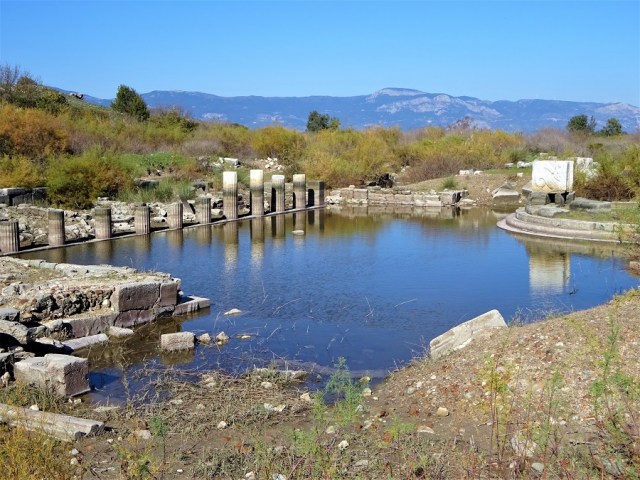
A further tease of what this city may once have been…
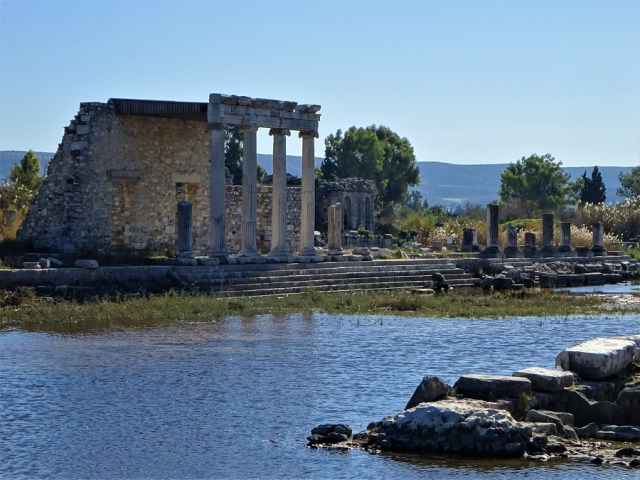
The Sacred Way: A little damp this time of year
Some time was spent in the aforementioned museum, which thankfully allowed us entry on our Ionian Museum passes, as otherwise it has an entrance fee in addition to the site itself (also on our pass).
There were some cool pieces on display, including those missing river gods we missed at the baths (okay, we didn’t miss them, but the ones out in the open were just replicas), but it was an aerial shot of the whole site that really caught my eye… even though I usually think photos of photos are pretty lame!
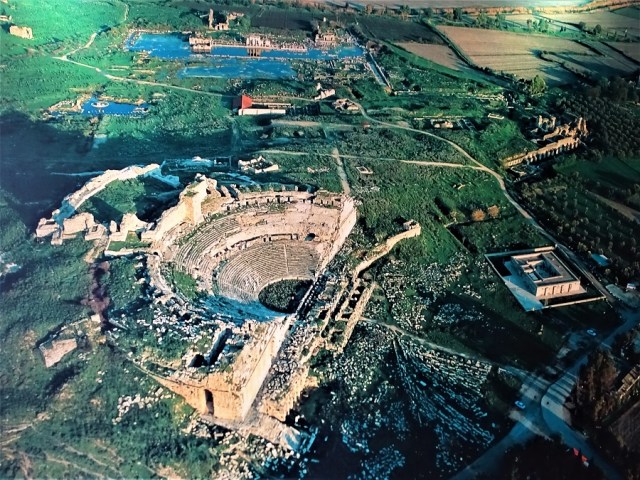
An even truer sense of its size! My photo of this aerial shot on display within the museum
Once done, we were soon back on the road and continuing south, following the path of the old Sacred Way (part of which you could see submerged above) towards the modern town of Didim.
It wasn’t our destination, rather something that helped spawn its name, and today sits within its modern bounds.
Ancient Didyma was what we sought, and most famously at the end of the Sacred Way sat the Temple of Apollo.
Only we couldn’t yet see it.
We were sat in a gravel carpark, seemingly surrounded by suburbia, so we decided it was as good a place as any for us to eat our lunch.
Sitting in the front to keep out of the wind, it quickly began to feel somewhat akin to being in a greenhouse, so it actually provided some relief when we did re-enter the outdoors.
It wasn’t long before we were again looking over The Sacred Way, by this point at its conclusion and oddly enough, through the gaps in a locked steel gate.

Eighteen kilometres from Miletus, the end of The Sacred Way
Huddled close beside the path we walked were a host of souvenir vendors who I’m sure have a far more enjoyable time of it in the summer, but in the early days of an admittedly sunny winter, they were either closed or half hearted in their efforts to lure our patronage.
Again brandishing our Ionian Museum passes (we felt we were getting value from these), we skipped the non existent queue, and we were in, metres away from the Temple of Apollo which once sported a hundred and twenty four columns (well, so said a nearby sign).
By the time of our arrival, the Didymaion (the oracle who gave the location its name and was second only to Delphi in fame in the ancient Grecian world) was long gone, and so were it looked, almost all of those columns.
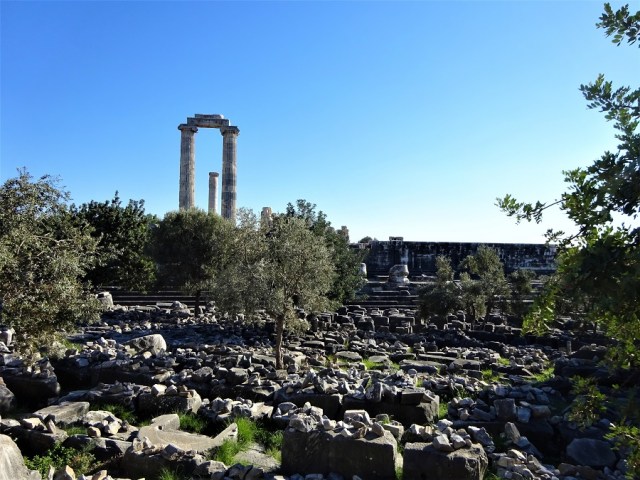
Today: Not quite a hundred and twenty four columns

You’d look a bit glum too with a crack right across your face…
We didn’t quite have the place to ourselves, but it was close enough.
In its day this place must have been something.
A vast complex of white stone that would have glistened on a day like today.
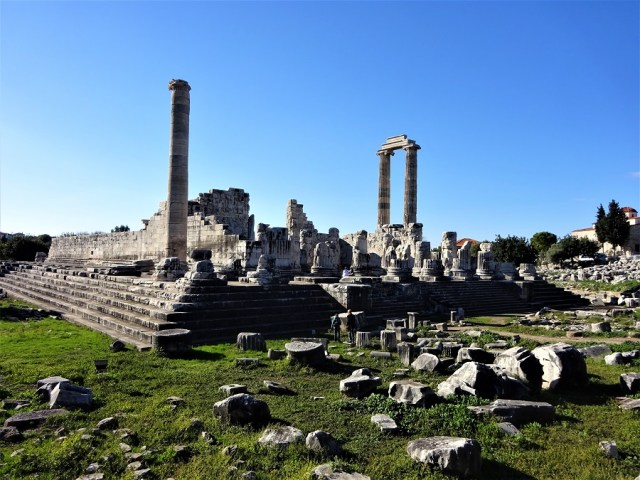
The Apollan Temple
Although not in the shadows, it is nevertheless a shadow of its former self, but at least the foundations remain to at least give us a true scope of its dimensions.
Then there are the columns.
As already highlighted, few of these continue to stand proud and erect, but even those that lie fallen serve as an indicator of how tall this ceiling must once have been.

Like roughly a hundred and twenty other columns…
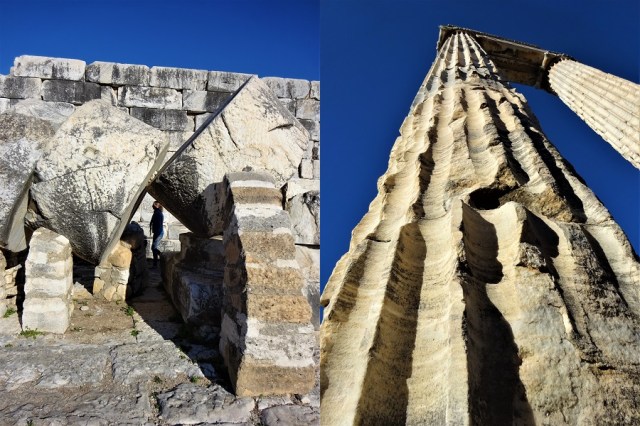
Giving a sense of scale (left) & One of the few still standing (right)
It might not have been on every support, but the friezes on those that stood like sentinels atop the main, grand entrance highlighted the level of artistry and indeed importance of the site.
Little surprise considering the regard for the resident oracle (being second only to Delphi remember).

Following in the footsteps of the second greatest oracle of the Grecian world
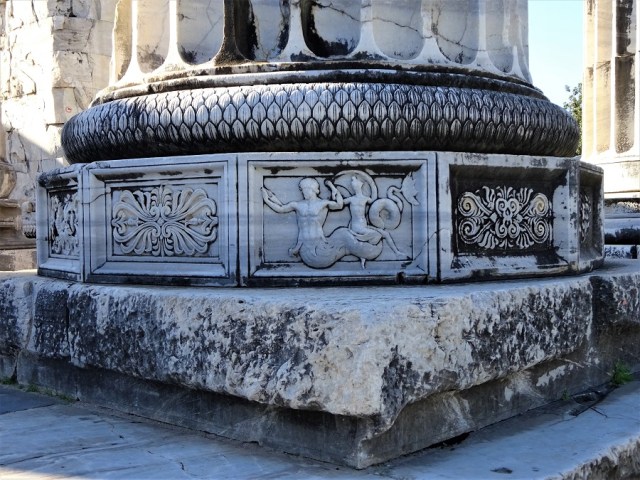
Even now, the detail is striking
By now we were well into the afternoon, but I still had this crazy notion that just maybe, we could sneak further south to Bodrum, and then say we’d ticked off two of the original Seven Wonders of the (Ancient) World in two days.
Sarah politely reminded me that she was driving and my earlier efforts at navigating when I had directions (admittedly, poor ones) hadn’t been the best start to the day.
How on earth would it go finding our way on the fly?!
Thus, the decision was made for us to call it a day and return to Selçuk, content after another day of ancient wonders.
Back on the roads, it certainly looked like we weren’t the only ones with this plan.
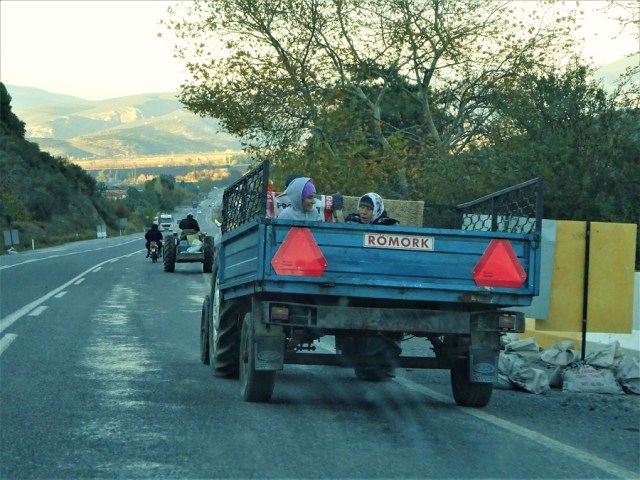
Heading home in a little more comfort than these locals
With around two hundred kilometres under our belts, and almost as many amphitheatres (okay, so maybe that is an exaggeration), we returned our hire car and Sarah was finally able to relax, possibly to be heard muttering under her breath something about not driving again for the remainder of our travels (after all, please remember this is all on the ‘wrong’ side of the road for us Australians)…
Notes:
* Our hire care from Troy Car cost us ₺80.00 Lire for the day, and we spent an additional ₺140.00 Lire on fuel (which was at least double what we needed to spend)!
* Entrance into Priene, Miletus and the Temple to Apollon (Didyma) was included as part of our Ionian Museum pass (separately, entrance cost ₺5.00 Lire, ₺10.00 Lire and ₺10.00 Lire respectively).
* The museum at Miletos requires a separate ₺10.00 Lire ticket, however it too was included on our Ionian Museum pass.
* There was a ₺3.00 Lire parking fee at the Miletos ruins.
 theworldwithchrisandsarah