Days: 221
Total distance travelled: 42,265.1 kilometres (26,251.61 miles)
Zipaquirá.
A name that just rolls off the tongue, and sitting about an hour and a half, almost due north of Bogota, our destination for a bit of a Sunday excursion with friends Chris & Faye.
We’d stumbled our way through the Transmilenio bus system to Portal del Norte, the transport hub from where we found our onward bus to Zipaquirá, where, with many other Sunday revelers, found ourselves deposited on the main road a short walk from the historical main plaza.
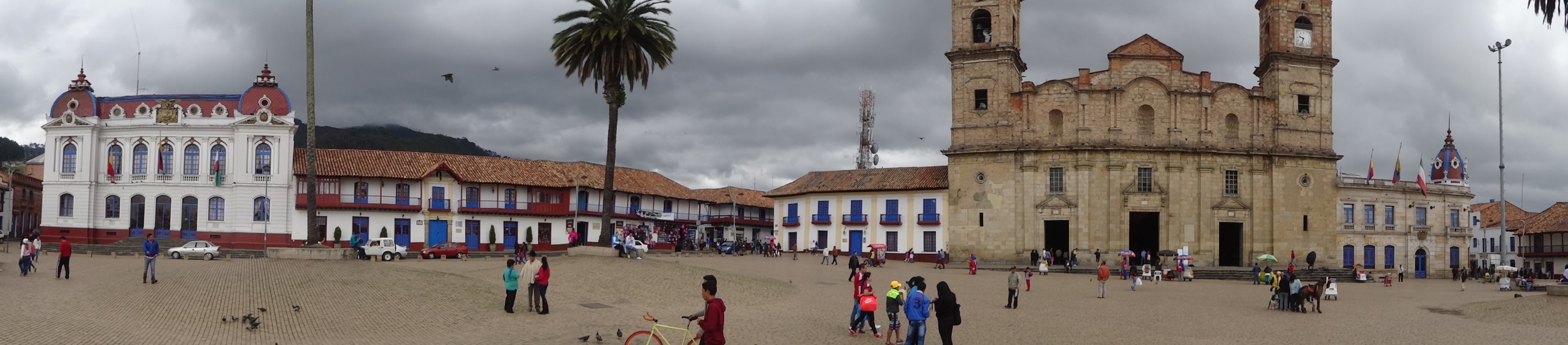
Zipaquirá’s main plaza (Click image to enlarge)
Unlike other towns with a colonial past, this one had a lot more colour co-ordination going on which was refreshing, and after Chris sorted out his finances with a quick trip to an ATM, we took a few minutes to check out yet another impressive Colombian church.
This place was a behemoth, and despite being full of people for a Sunday service, still felt cavernous!
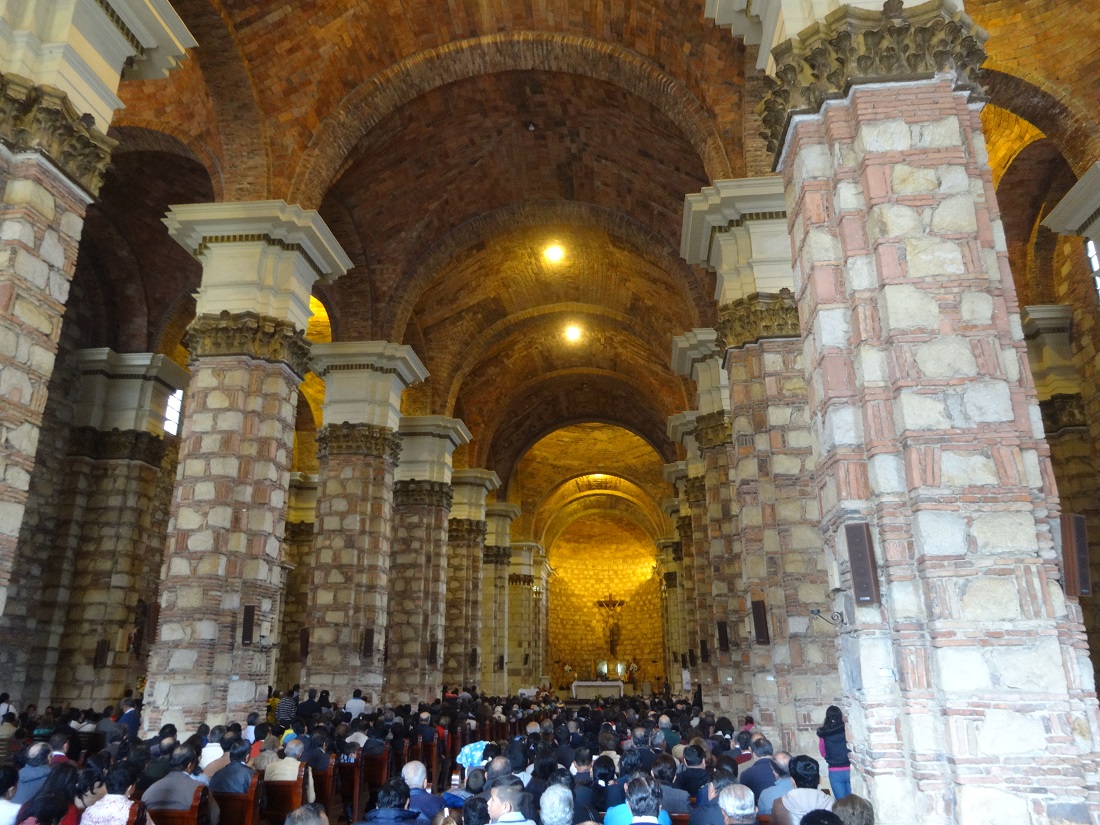
Colombia delivers yet another impressive religious haven
But believe it or not, it wasn’t a church we were here for, although our primary purpose was ridiculously similar.
Forget a church, we wanted something more, a cathedral, or more precisely, the Catedral de Sal (Salt Cathedral)!
A short walk up a hillside and we were there, Sarah & I joining a ridiculously long queue whilst Chris & Faye utilised the restrooms.
It was one of those situations where you don’t even begin to consider what day of the week it is (happens quite often when you travel), as this is often one of the few work free days for many local people. Not forgetting they are mostly incredibly pious, this queue all of a sudden made a lot of sense.
So how does one make a cathedral from salt? Well, we were about to descend into a salt mine to discover the answer for ourselves!
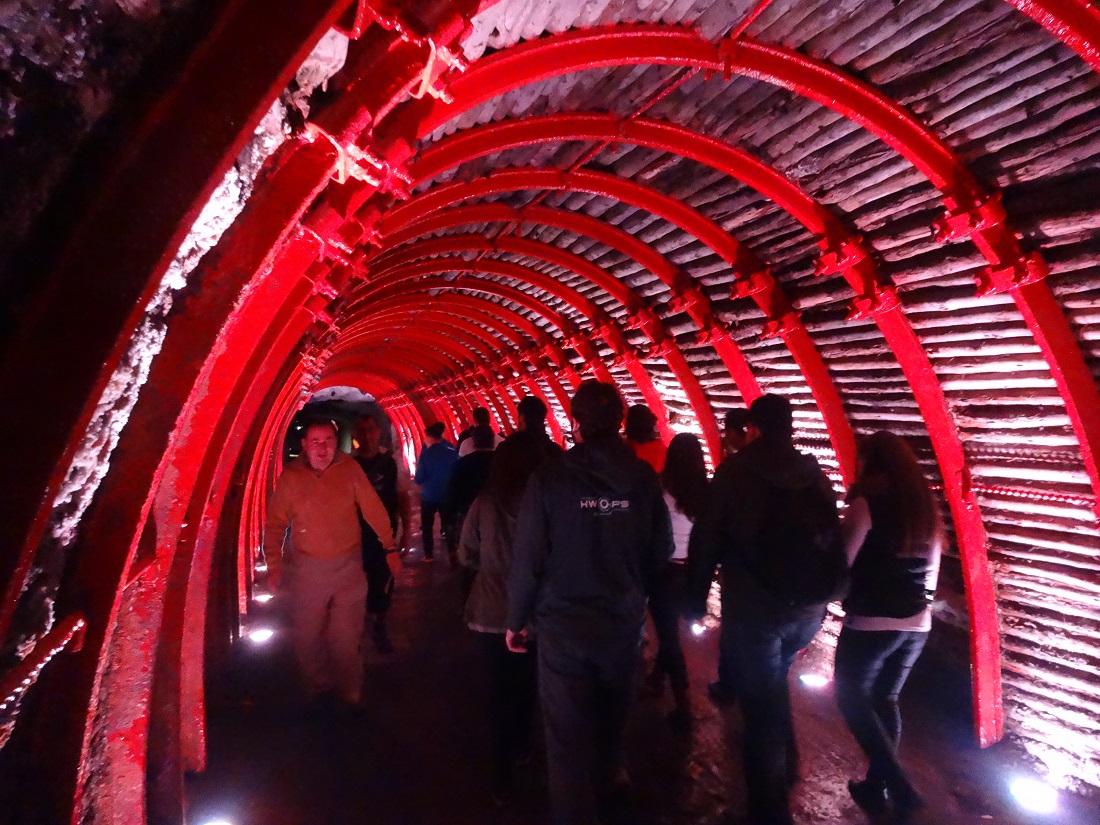
Our descent into madness… or at least a salt mine
The level we would be exploring was at about 180 metres from the surface, although given that the mine has been dug inside a hill or mountain, one could assume that this depth varies, dependent upon where exactly within the mine you are.
As a preamble to the cathedral itself, our first sights came in the form of 13 large caverns, each with its own cross, carved directly from the surrounding stone and each created in a slightly different manner.
Apparently these somehow depicted the trials of Christ, something that was lost on us, however the workmanship and clever lighting certainly presented us with something beautiful.

Time to get cross… apparently the 13 trials of Jesus (well at least 2 of them here)
Eventually, after enduring the trials and pushing our way through the crowds, we got our first look, admittedly from a balcony viewing point, the Catedral de Sal.
Despite not having a religious bone in our bodies, it was still impossible not to be wowed or impressed by what has been constructed here.

A first peek at the Catedral de Sal
It obviously therefore warranted further investigation, so we found our way down to the main level to properly observe and explore this cathedral dug out of an ancient salt mine (although the mine has been in operation since Spanish times, parts of it are still worked to this da).
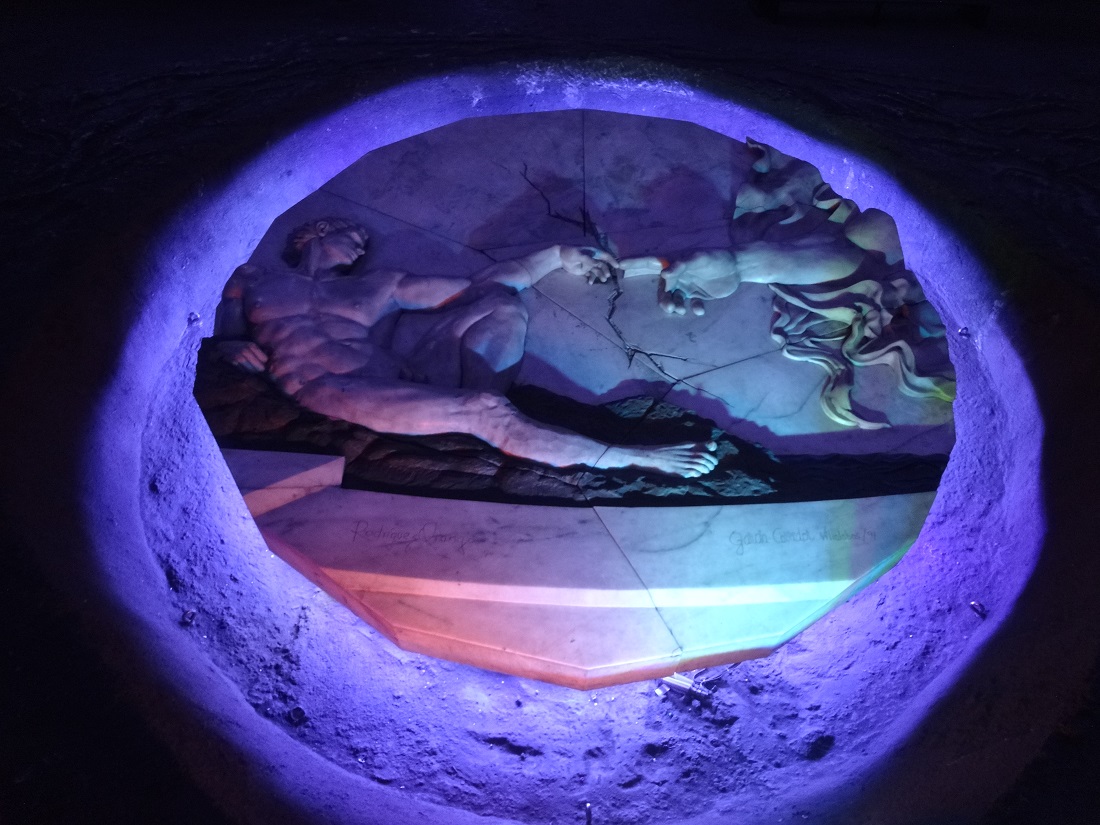
Channeling a little creation through a seal on the floor
The place was incredibly expansive, hosting overpriced eateries as well as tacky souvinir shops (the product of which was being devoured by God hungry Colombians).
There was a quite impressive mirror pool, an incredibly still pool of water that perfectly reflected the illuminated ceiling above it, but we still had something a bit more tacky with which to finish our experience.
For, included in our ticket price, was also entrance into their sound & light show. It got to the point, a bit like our time at Viejo Oeste in Mexico, where it was so bad, it was good!
With our time done, we indulged in a delicious lunch of roasted meats from a nearby eatery, perfectly positioned by their cooking fire which allowed us to remain warm, whilst the weather took a turn for the worse.
If you’re in Colombia, and especially Bogota, do yourself a favour and check this amazing feat of construction (which is essentially a piece of art) out for yourself.
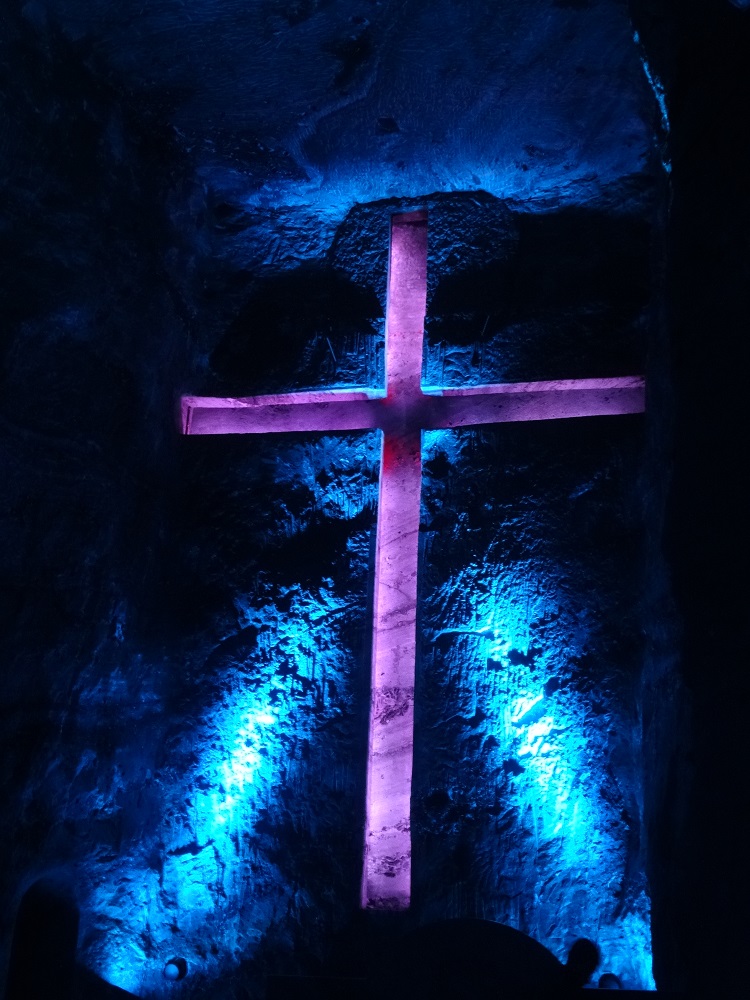
Incredibly, carved within the rock…
Notes:
* A Transmilenio bus ride cost us all $1500.00 COP per person each way (we didn’t purchase a card, but instead paid for the credit to go on another passengers card and used theirs) to the bus terminus, Portal del Norte.
* Buses from Portal del Norte to Zipaquirá cost us $4,300.00 COP each outbound, but for some unknown reason, $4,500.00 COP to return…
* The minimum entrance fee (which we paid) was $23,000.00 COP per person which granted access only to the mines and cathedral (other prices included access to a climbing wall, Brine Museum and other sites).
 theworldwithchrisandsarah
Cool! Can’t wait to go.
I’ve never been to this particular over the top attraction, but I’ve been to my share. It’s like: 1. Start with a really cool, natural wonder, 2. add some bling so as to make it an ‘experience’ for tourists 3. charge accordingly!
In this part of the world, add a splash of god and the money flows even more freely! The place was packed!
I´m not sure if I would visit de Salt Cathedral. I know the construction is impressive, but I had a bad experience with salt church before (in Poland). Dark, deep and overcrowded places are not my thing. Although the lunch near the fire sounds like a good spot to wait for the friends who are doing the visit.
😀
Nat
It was beautiful, but we made the error of visiting on a Sunday when the place was likely at its busiest (full of local visitors)!
Can’t believe you’re almost making one year of traveling! Cool post!
Almost there (in a couple of days)! Feels crazy for us too! 🙂
That is just amazing! I’m adding this to our list of places to see. Kids are fascinated by the concept of salt being mined…hard to wrap their heads around. 🙂 What a really, really cool place! Thanks for sharing.
Natalie, The Educational Tourist
Was certainly something different. Whether your religiously motivated, or just like us there to see the amazing stonework (and it was a bit of a novelty)! One tip, try and avoid going on a Sunday 😉
What an incredible, fascinating place. I’m not sure how I’d get on with the crowded dark spaces… may have make sure we go at a quieter time!… would still love to see this for myself though so will have to get over it. Great post Chris :).
The salt palace is very interesting. I am always amazed at the devotion that inspires these kinds of labors of love.